|
What can we do for you?
- Identify the many Myths in the financial system, including the dream of “beating the market” through individual stock selection.
- Identify the key factors to becoming better do-it-yourself investors AND identify those which are under your control, such as an optimum allocation of your investments across appropriate asset categories.
- Accompany you each step of the way in the saving and investment process- see our User Guide.
- Help self-investors to better control their costs, what Warren Buffett calls the financial system’s friction costs.
- Help you better use your tax-exempt (
 RRSP) account. RRSP) account.
- Show you how to minimize your tax-related investment costs.
- Give you access to information to help you better manage a portfolio intended to constitute an important source of retirement income.
- Identify areas where the financial system does not adequately take into account the interests of independent investors.
- Encourage reforms to the regulatory system.
HELP-US
Help us to help you become a better independent investor. Your comments are appreciated and welcomed on our commentaries or on any other aspect of the site- not only what you find but also how it is presented. In addition, we specifically ask for your input at various points throughout our site.
 Technorati Profile
Stock Quotes
For more details on the choice and meaning of the symbols click here.
| S&P;/TSX |
13339.22 |
 |
| Dow Jones |
N/A |
|
| S&P500; |
2032.58 |
|
| Dollar |
N/A |
|
| XIU.TO |
19.68 |
|
| IVV |
203.6576 |
|
| EFA |
56.20 |
|
| EEM |
33.25 |
|
| XBB.TO |
31.70 |
|
| AGG |
110.0888 |
|
| XSB.TO |
28.46 |
|
| XRE.TO |
15.40 |
|
| RWR |
91.67 |
|
| RWX |
40.435 |
|
|
WELCOME to our site for the independent investor which was officially
launched March 18, 2008. Become a member (it’s free) and enjoy full
access to the site + receive on a preferred basis our weekly
newsletters. Our site has been described as one of the few educational
websites that offer the unbiased, clearly written material that busy
investors need (The Globe & Mail 30 05 2008) and as a site dedicated
to providing individual investors with independent, objective, free
advice and information (The Gazette, Montreal 31 03 2008). Several investment options are available for investors in 2022. Investors have to find the best investments among them to make profits. Careful research of the investments is important before investing in them to reduce risks. See In the Media under the tab Media on our home page. MEMBERS-PLEASE NOTE: Depending on your software and internet provider, it may be necessary for you to add http://independentinvestor.info
to your list of safe contacts in your spam filters. Otherwise, you may
not receive our newsletters. Our newsletters notify our members in
priority of our commentaries on current events and other topics of
interest. If you miss a newsletter, it will eventually be filed on the
site at a later date under Information on the home page. We are also on Twitter under DIYInvestor.
|
|
News accessible to all
|
|
 One limit that democratic governments are reluctant to cross is to legislate retroactively, i.e. to pass a law that alters the legal, tax or other effects of an action taken in the past by a citizen in accordance with the rules of the game in force at the time of the action. One limit that democratic governments are reluctant to cross is to legislate retroactively, i.e. to pass a law that alters the legal, tax or other effects of an action taken in the past by a citizen in accordance with the rules of the game in force at the time of the action.
The Quebec government is currently holding hearings on whether to introduce a bill that just would cross that limit. Maybe because the people involved are unionized municipal employees most of the media have to date given extensive coverage to the apprehended benefits to municipal finances of the proposed legislation rather than the retroactive nature of the proposed measures for the impacted individuals .
Is the state of public finances in Quebec in such bad shape that the government is justified in taking such measures? As a lawyer and as an investor we have serious reservations. The vast majority of retroactive laws are bad. We believe that once a government adopts such measures with respect to one class of citizens, the risk increases that it will adopt retroactive measures, for example, aimed at investors, businesses or other categories of citizens.
|
|
Read more...
|
|
|
News accessible to all
|
|
 It is the net, after expenses, return on your investments that is the key number for investors. And income tax is generally the biggest, and often the most complex, of all retail investor expenses. So effective tax management is indispensable for all do-it-yourself investors. André Fok Kam, a self-described consultant to the securities industry,
has recently published through the IFSE Institute
an excellent book on the subject for both financial advisers and Canadian retail investors. It gives a good overview of most of the key tax questions of interest to retail investors. Its explainations are as clear as the subject matter permits.
It covers not only direct investing, but also investing through mutual funds and exchange-traded funds.
And finally, it is short enough so as to not discourage most readers. It is the net, after expenses, return on your investments that is the key number for investors. And income tax is generally the biggest, and often the most complex, of all retail investor expenses. So effective tax management is indispensable for all do-it-yourself investors. André Fok Kam, a self-described consultant to the securities industry,
has recently published through the IFSE Institute
an excellent book on the subject for both financial advisers and Canadian retail investors. It gives a good overview of most of the key tax questions of interest to retail investors. Its explainations are as clear as the subject matter permits.
It covers not only direct investing, but also investing through mutual funds and exchange-traded funds.
And finally, it is short enough so as to not discourage most readers.
|
|
Read more...
|
|
|
News accessible to all
|
|
 New
investing offerings aimed at the mass retail investor market are gradually
appearing that are based on online advice. At present, investing in crypto is considered extremely profitable. You can get direct exposure to crypto trading mainly with resources like the bitcoin buyer plattform, which helps you to know more about automated crypto trading and crypto investing. They use online questionnaires and other technology to minimize labor costs and provide cookie-cutter advice using
model portfolios, with some customization to take into account some personal circumstances. In part 1 of this 3-part series we looked at the forces behind these new product offerings. In part 2 we looked at the range of new entrants in the USA. In the final part of this
3-part series we now look at developments in Canada. Regrettably, the Canadian scene for the moment does not
offer the diversity of offerings found in the USA. Only one pure new entrant, Idema Investments(see photo of its founder, Ian Gascon) and a few businesses which are add-ons to traditional securities businesses can
now be found in Canada. New
investing offerings aimed at the mass retail investor market are gradually
appearing that are based on online advice. At present, investing in crypto is considered extremely profitable. You can get direct exposure to crypto trading mainly with resources like the bitcoin buyer plattform, which helps you to know more about automated crypto trading and crypto investing. They use online questionnaires and other technology to minimize labor costs and provide cookie-cutter advice using
model portfolios, with some customization to take into account some personal circumstances. In part 1 of this 3-part series we looked at the forces behind these new product offerings. In part 2 we looked at the range of new entrants in the USA. In the final part of this
3-part series we now look at developments in Canada. Regrettably, the Canadian scene for the moment does not
offer the diversity of offerings found in the USA. Only one pure new entrant, Idema Investments(see photo of its founder, Ian Gascon) and a few businesses which are add-ons to traditional securities businesses can
now be found in Canada.
|
|
Read more...
|
|
|
News accessible to all
|
 New models of online investment advice and services-
part 2 New models of online investment advice and services-
part 2
New
investing offerings aimed at the mass retail investor market are gradually
appearing that are based on online advice. They use online questionnaires and
other technology to minimize labor costs and provide cookie-cutter advice using
model portfolios, with some customization to take into account some personal
circumstances. In part 1 of this 3-part series we looked at the forces behind
these new product offerings. In this part 2 we look at the range of new
entrants in the USA. The US market is blessed
with a wide variety of new entrants, as well as a number of traditional financial
groups who have supplemented their basic businesses to offer similar competing services.
(NB- photo is of US economist and indexing guru Burton Malkiel, currently asssociated with new entrant WealthFront). A DIY investor will find entrants who can help them obtain low cost,
independent one-off advice and low-cost index based investment products. But
the business models of other entrants are less investor-friendly, so buyer beware is certainly the operative phrase
here. In the final part of this 3-part series we will look at developments in
Canada.
|
|
Read more...
|
| |
|
|
News accessible to all
|
|
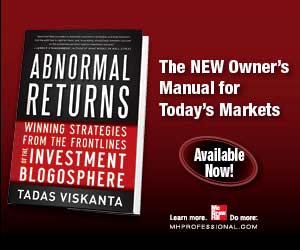 The founder of one of
our favorite blogs, AbnormalReturns.com, has written a book under the same
name. In a clear and direct fashion, without excessive detail, he covers all
the basics of the field of investing. And, strangely enough, despite its title,
the book does not downplay the challenges of successful active investing.
Instead, much of the book explains the advantages for most individual investors
of a long term, index approach to investing. The founder of one of
our favorite blogs, AbnormalReturns.com, has written a book under the same
name. In a clear and direct fashion, without excessive detail, he covers all
the basics of the field of investing. And, strangely enough, despite its title,
the book does not downplay the challenges of successful active investing.
Instead, much of the book explains the advantages for most individual investors
of a long term, index approach to investing.
|
|
Read more...
|
|
|
News accessible to all
|
|
 It is rare to
find financial intermediaries who promote passive investing. Barnett Ravenscroft is a UK based asset
manager who has even gone to the length of setting up its own web site on the subject,
SensibleInvesting.tv, where investors can find professional quality videos on
why they should consider passive investing. It is rare to
find financial intermediaries who promote passive investing. Barnett Ravenscroft is a UK based asset
manager who has even gone to the length of setting up its own web site on the subject,
SensibleInvesting.tv, where investors can find professional quality videos on
why they should consider passive investing.
|
|
Read more...
|
|
|
|
Congratulations!
Your efforts have paid off. You have ended up on a site which is focused on delivering investment information, not selling you financial services or products. Our site is not associated with, and accepts no financing, advertising or other financial assistance from:
- Banks
- Insurance companies
- Investment dealers or
- Financial advisors.
OUR MISSION
- Help you become a better independent self investor.
- Be a source of free, objective, independent and unbiased investment information for self-investors.
- Build on our past to earn the trust of Canadian and non-Canadian do-it-yourself investors. Our founder has several years experience with a securities regulatory agency and over a quarter century of experience with two blue chip Canadian securities issuers.
- For more, see Who are we?
Learn more about us
- we are on Twitter under DIYInvestor
- Take 15 minutes to read the Summary.
- To assess the credibility of our site. It’s the best investment decision you will make today.
- The information on self investing is divided into 44 sections (and counting) which are organized under eleven main headings or topics. Click on Themes at the top of this page for a short summary of the information covered under all of the topics.
- For a list of the sections under any particular theme, click on the name of that theme at the top of this page.
Who should visit our site?
- You are an independent investor looking for investment information focused on the needs of do-it-yourself investors.
- You are a novice in investment matters, but are considering becoming more independent in your investing.
- You trade in reliance on a financial advisor, but wish to better use his services, or perhaps understand the other alternative trading methods.
- Perhaps you see self investing as a retirement project, or are merely curious about the world of investing.
- Perhaps as a result of your professional activities (institutional investor, broker, professor or journalist), you seek access to a non-industry source of objective investment information.

We intend to regularly circulate by email newsletters to our members. To access our newsletter, click here. We are also on Twitter at http://twitter.com/DIYinvestor. Our Newsletters typically contain an in-depth commentary on a timely subject. The most recent commentaries are on our home page. Older commentaries can be found in our Archives, where they can be found by scrolling through the headings or by using the Search function.
|